
If you’ve ever heard a pump that sounds like it’s pumping gravel, you’ve heard cavitation. It’s one of the most common causes of pump damage, and almost always it comes down to one number: NPSH. Here’s what NPSH means, why a shortage of it destroys pumps, and how to make sure your pump has enough.
What Does NPSH Stand For?
NPSH stands for Net Positive Suction Head. In plain English, it’s the amount of pressure a liquid has at the pump inlet above the pressure at which it would boil. It’s expressed in feet (or meters) of the liquid being pumped.
Every liquid has a vapor pressure: the pressure at which it turns to vapor at a given temperature. Water at 60°F has a vapor pressure of only about 0.26 psia, so it stays liquid easily. Water at 212°F has a vapor pressure of 14.7 psia, the same as the atmosphere, so in an open tank it’s right at the boiling point. Liquefied gases like propane and ammonia are stored at their vapor pressure all the time.
NPSH is simply the cushion between the pressure at the pump suction and the liquid’s vapor pressure. The bigger the cushion, the less likely the liquid is to boil inside the pump.
NPSHa vs. NPSHr
There are two NPSH numbers, and comparing them is the whole game:
- NPSHa (NPSH available) is what your system provides. It depends on your tank, piping, liquid temperature and elevation. You calculate it.
- NPSHr (NPSH required) is what the pump needs to avoid cavitating. It depends on the pump’s design, speed and flow rate. The pump manufacturer publishes it on the pump curve.
The rule: NPSHa must be greater than NPSHr, with a safety margin. Published NPSHr is typically the point where the pump has already lost about 3% of its head to cavitation, so running with NPSHa just equal to NPSHr means the pump is already cavitating.
What Is Cavitation?
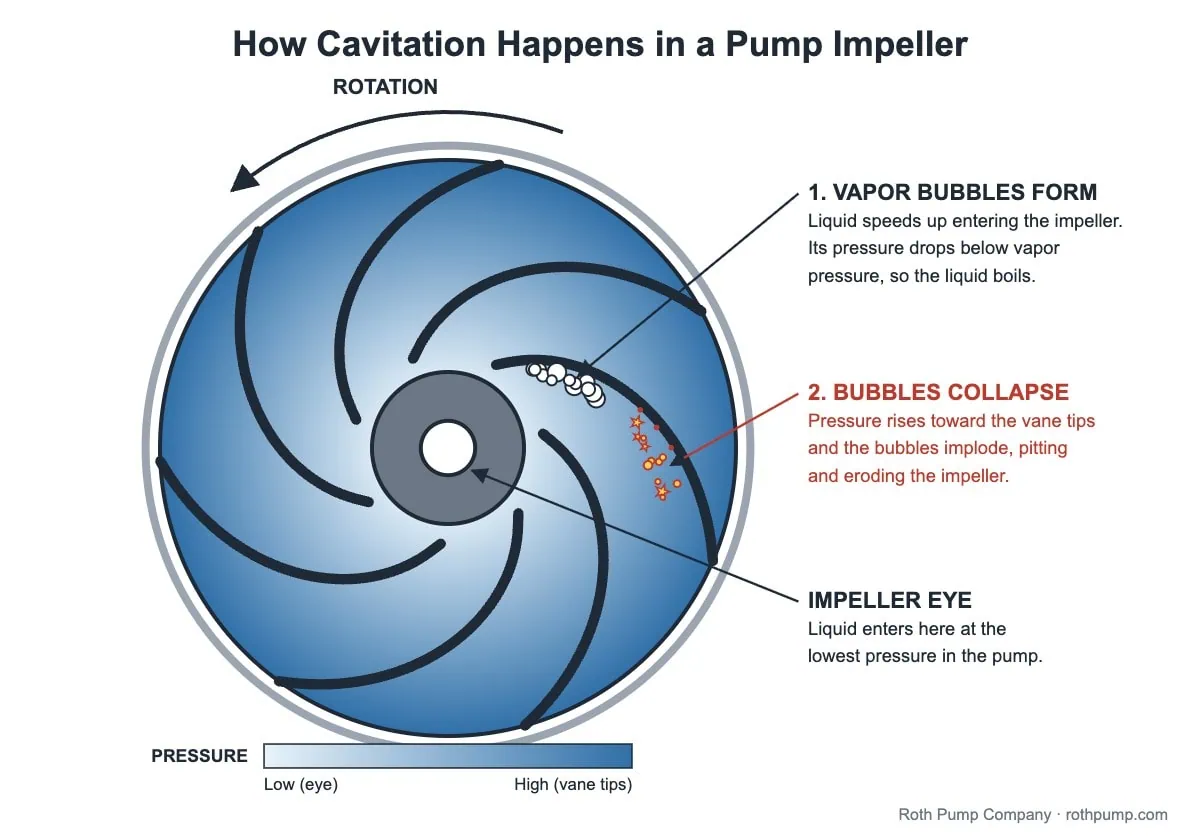
As liquid enters a pump, it speeds up at the inlet of the impeller, and its pressure drops. If that pressure falls below the liquid’s vapor pressure, the liquid boils right there inside the pump and forms vapor bubbles, even if the liquid is cold.
Those bubbles are then carried into higher-pressure areas of the pump, where they collapse violently. Each collapse fires a tiny, high-velocity jet of liquid against the metal. Millions of them, over and over, tear away at the impeller and casing. That’s cavitation.
Signs your pump is cavitating
- A noise like gravel, marbles or popcorn rattling through the pump
- Excess vibration
- Lower flow or discharge pressure than the pump curve predicts, or pressure that fluctuates
- Pitted, sponge-like erosion on the impeller vanes, especially near the inlet
- Repeated mechanical seal and bearing failures
Cavitation doesn’t just wear out impellers. The vibration it causes shortens the life of seals and bearings, and in severe cases the pump can lose prime entirely.
How to Calculate NPSH Available
NPSHa (in feet) is calculated like this:
- NPSHa = 2.31 × (Psurface − Pvapor) ÷ SG + Hstatic − Hfriction
Where:
- Psurface is the absolute pressure on the liquid surface in the supply tank, in psia (14.7 psia for an open tank at sea level)
- Pvapor is the liquid’s vapor pressure at the pumping temperature, in psia
- SG is the liquid’s specific gravity (see our chemical boiling point and specific gravity chart)
- Hstatic is the height of the liquid level above the pump centerline, in feet (negative if the pump is above the liquid, a suction lift)
- Hfriction is the friction loss in the suction piping, valves and fittings, in feet
Our free NPSH Calculator does the math for you.
Example 1: Cold water from an open tank
Water at 60°F (vapor pressure 0.26 psia) is pumped from an open tank at sea level. The water level is 5 ft above the pump and suction friction loss is 2 ft.
NPSHa = 2.31 × (14.7 − 0.26) ÷ 1.0 + 5 − 2 = about 36 ft
That’s plenty for almost any pump. Cold water rarely has NPSH problems.
Example 2: Condensate at 212°F
Now the same tank holds condensate at 212°F in a vented receiver. The vapor pressure is 14.7 psia, exactly equal to the pressure on the surface, so the pressure term is zero. With 3 ft of liquid above the pump and 1 ft of friction loss:
NPSHa = 0 + 3 − 1 = 2 ft
Many standard centrifugal pumps need 6 to 10 ft or more of NPSH. Put one on this receiver and it will cavitate. Hot water, condensate and boiler feed water are where most NPSH problems happen, along with liquefied gases and volatile solvents stored at their boiling point.
Don’t forget altitude
Atmospheric pressure drops as elevation rises. In Denver it’s about 12.2 psia instead of 14.7, which costs roughly 6 ft of NPSHa on an open water tank.
How to Prevent Cavitation
You can fix an NPSH problem from either side: raise NPSHa or lower NPSHr.
Increase NPSH available
- Raise the supply tank or lower the pump to add static head.
- Reduce suction friction with a larger-diameter, shorter suction line, fewer elbows and fittings, and clean strainers.
- Never throttle the suction valve to control flow. Throttle on the discharge side instead.
- Lower the liquid temperature, if the process allows, to reduce vapor pressure.
- Pressurize the supply vessel above the liquid’s vapor pressure.
Choose a pump with lower NPSH required
Often the tank height and liquid temperature are fixed, and the practical answer is a pump designed to run on very little NPSH. Roth Pump has designed and built pumps since 1932. Roth regenerative turbine pumps with inducer stages require as little as 1 ft (0.3 m) of NPSH, so they can pump liquids at or near their boiling point without cavitating:
- Low NPSH Chemical Pumps for solvents, liquefied gases and volatile chemicals
- 1 ft NPSH Sealless Magnetic Drive Pumps for hazardous liquids (read how mag drive pumps handle near-boiling liquids)
- Chemical Multistage Low NPSH Pumps and Industrial Multistage Low NPSH Pumps for higher pressures
- Boiler Feed Pumps and Steam Condensate Return Systems for hot water and condensate up to 212°F and beyond
Quick Summary
- NPSH is the pressure margin between the liquid at the pump inlet and its boiling point.
- NPSHa is what your system provides; NPSHr is what the pump needs.
- When NPSHa falls short, the liquid boils inside the pump and the collapsing bubbles cause cavitation damage.
- Hot water, condensate, liquefied gases and volatile liquids are the most common problem services.
- Fix it by increasing NPSHa or choosing a low-NPSHr pump.
Need Help with an NPSH Problem?
Check your system with our NPSH Calculator, or send us your liquid, temperature, tank pressure, liquid level and flow, and we’ll recommend a pump that won’t cavitate. Contact Roth Pump, call 1-888-444-ROTH, or find your local Roth representative.